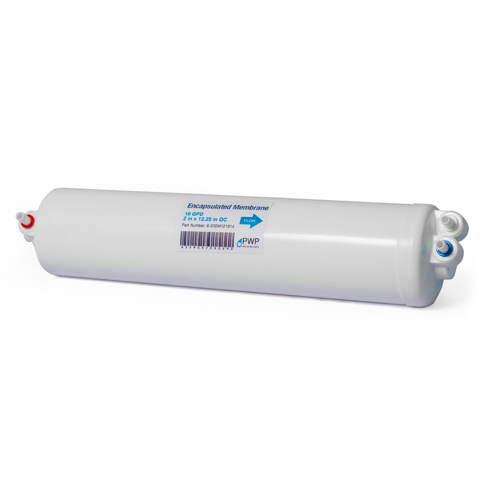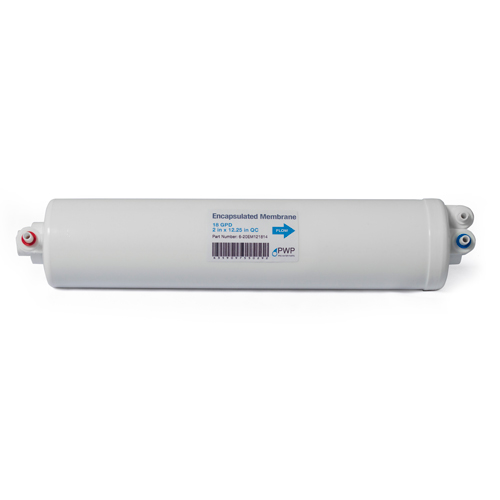
Reverse osmosis (RO) is a water purification technology that uses a semipermeable membrane to remove ions, molecules and larger particles from drinking water. In reverse osmosis, an applied pressure is used to overcome osmotic pressure, a colligative property, that is driven by chemical potential differences of the solvent, a thermodynamic parameter. Reverse osmosis can remove many types of dissolved and suspended species from water, including bacteria, and is used in both industrial processes and the production of potable water.
The membrane assembly consists of a pressure vessel with a membrane that allows feedwater to be pressed against it. The membrane must be strong enough to withstand whatever pressure is applied against it. Reverse osmosis membranes are made in a variety of configurations, with the two most common configurations being spiral-wound and hollow-fiber.



most sophisticated type of filter
creates the purest water
many layers of material allowing for more dirt trapping
features a drain so that large particles can be easily flushed out
drinking water treatment
membrane type:
composite polyamide membrane
nominal size |
2in x 12.25in |
2in x 12.25in |
connection |
1/4in quick connect |
1/4in quick connect |
productivity rate |
18gpd +/- 15% (2.8lph) |
100gpd +/- 15% |
pressure: range |
2.1 to 10.3 bar |
30 to 100 psi |
pressure: recommended use |
4.1 bar |
60 psi |
pH |
4.0 to 11.0 |
2.0 to 11.0 |
temperature |
4 to 45 ºC |
40 to 113 ºF |
minimum concentrate flow |
4 times permeate flow |
4 times permeate flow |
maximum feed concentration |
750 ppm |
|
maximum feed flow turbidity |
5 NTU |
1 NTU |
maximum feed silt density |
5 SDI |
5 SDI |
chlorine tolerance |
0 |
0 |
minimum rejection |
95% |
95% |
About | Contact Us | Resources
Phone: 770.420.6447 | Toll Free: 877.658.9009 | sales@prowaterparts.com | Terms & Conditions
Copyright © 2019 ProWaterParts.com